
The Big Picture
Gyndore in one pass: three moves around cbBTC that feed each other, fee routes that pay real users, and rules that do not move after launch.
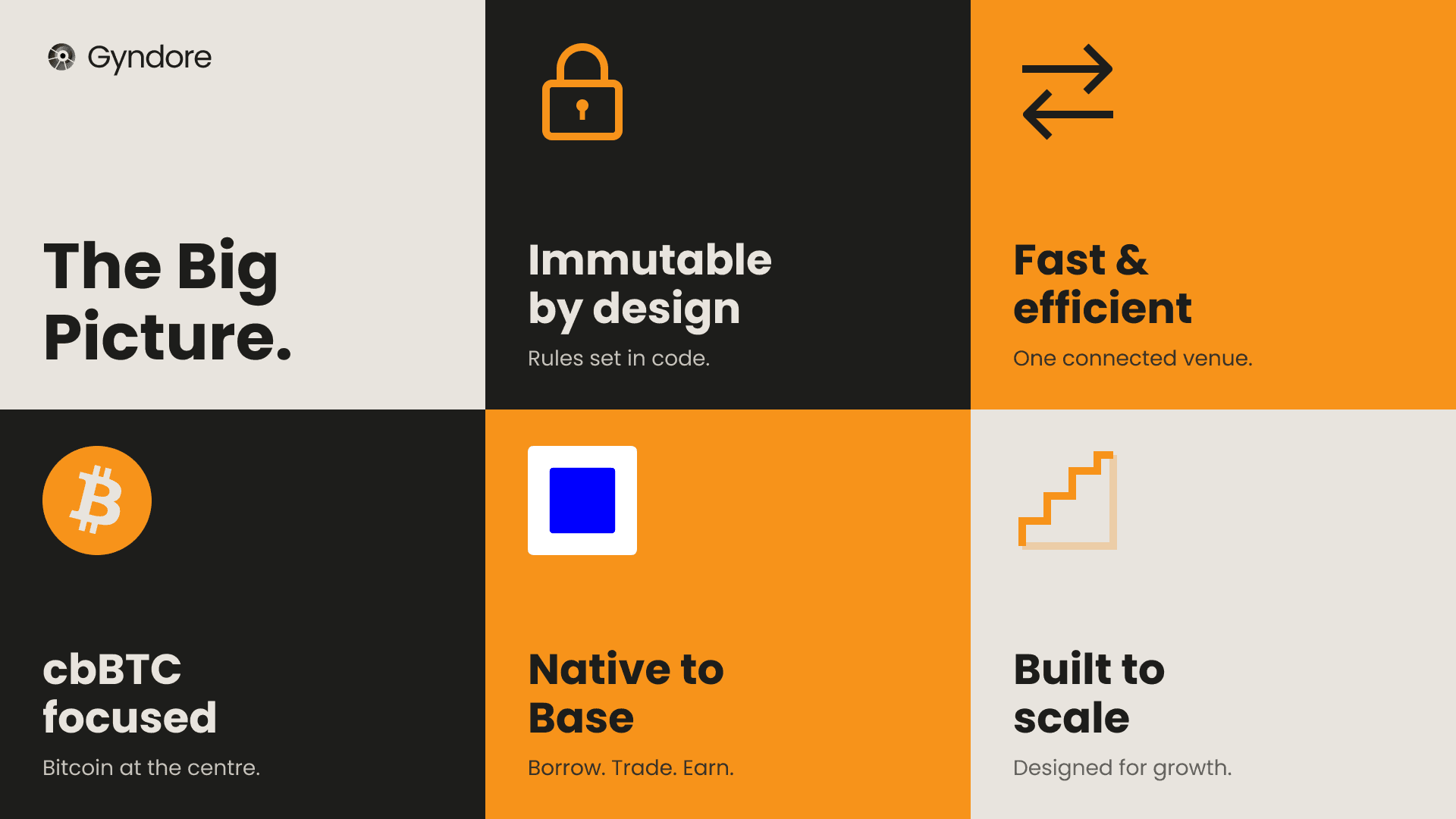
One unified system
Gyndore is the Bitcoin liquidity hub of Base. It is built around cbBTC, Coinbase's token backed 1:1 by Bitcoin, so holders can borrow against it, trade it, and earn on it without stitching those moves together across generic venues. Under the surface that is several protocols deployed as one. From the outside there are only three moves, and all three sit on the same asset.
Each move works alone. You can borrow without trading, provide liquidity without opening a loan, or earn without doing either. What makes them one venue is that they keep collateral, dollars, fees, and activity in the same place instead of leaking out. The Three Pillars has the product detail for each surface.
The loop
Borrowing is where the loop starts. Deposit cbBTC, mint dollars against it, and keep the Bitcoin. Those dollars are gynUSD. Interest borrowers pay is shared: a portion goes to people on the earning side, and a portion goes to GYND and bGYND stakers. None of it goes to a company. That is what makes the yield real: nothing is printed to fund it. Those dollars need a market, and so does the collateral. Trading is the concentrated-liquidity DEX built around Bitcoin on Base. Liquidity providers keep 80% of every swap fee. The protocol takes a fixed 20%, keeps none of it, swaps it to USDC, and pays it to GYND and bGYND stakers. Nothing in that route depends on a discretionary cut later.
Why it compounds
Each turn of the loop makes the next one cheaper to run. More borrowing pays more interest into earning, which draws more deposits, which makes the ecosystem more useful to scale. Deeper pools cut slippage, attract volume, and grow the USDC paid to stakers. Dedicated Bitcoin markets keep that volume on Base instead of sending it through generic venues that take the fees elsewhere.
Incentives are issued as bGYND rather than as a token that only hits the market. Converting them into GYND funds protocol-owned liquidity and GYND buybacks, so growth leaves assets behind instead of only sell pressure. Bonded Model covers that conversion path.
Where the value goes
Borrower interest is shared between earning depositors and GYND and bGYND stakers. The DEX's fixed fee cut and revenue from cbBTC staking also pay GYND and bGYND stakers in USDC. The protocol keeps none of what the DEX earns for it. Stake either token, start earning, and claim whenever you want: no lock-ups, no vesting, and nothing to vote on. One bGYND counts as one GYND in the staking pool.
GYND supply is fixed at 10,000,000. Rewards are funded by what the platform has already earned, not by inflating that supply. Tokenomics Overview and Fees & Revenue follow the money.
What stays fixed
The product stays narrow on purpose. One collateral: cbBTC. Markets built around Bitcoin rather than a shared multi-asset basket. Fee routes that pay protocol stakers rather than an outside operator. The stablecoin protocol and the DEX are immutable: no admin key, no upgrade path, no discretionary levers that rewrite the deal later. What you read here is what the contracts do.