
Tokenomics
Fees & Revenue
Revenue comes from more of the ecosystem than borrowing alone, and every route it takes is written into immutable contracts.
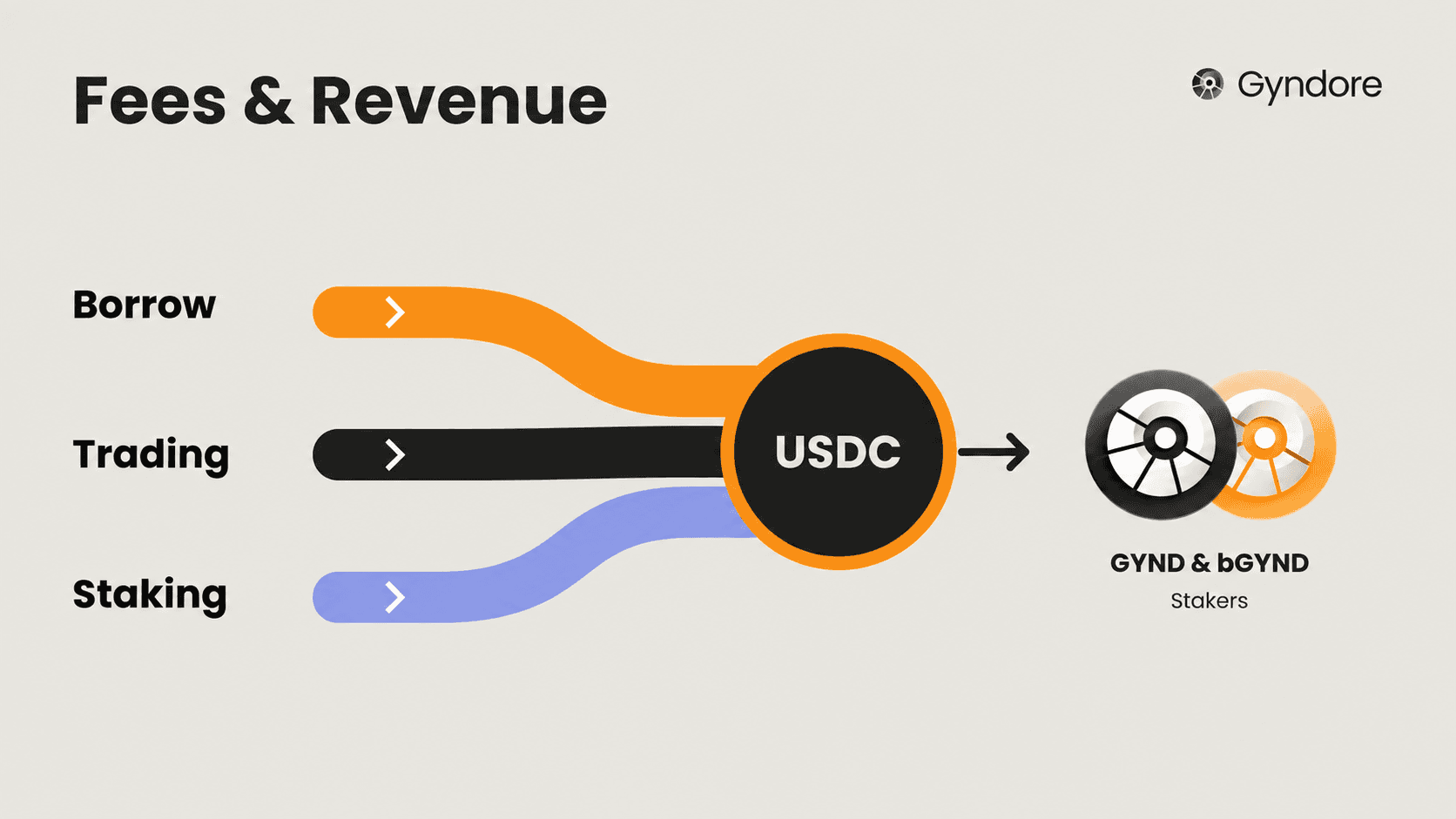
Revenue sources
The CDP system generates borrower interest on what borrowers mint, and the DEX generates trading fees. Revenue from cbBTC staking also flows to GYND and bGYND stakers.
Borrower interest is shared between earning and GYND and bGYND stakers. The DEX pays token holders too: the protocol takes a cut of every swap and passes 100% of it through to GYND and bGYND stakers, keeping nothing for itself.
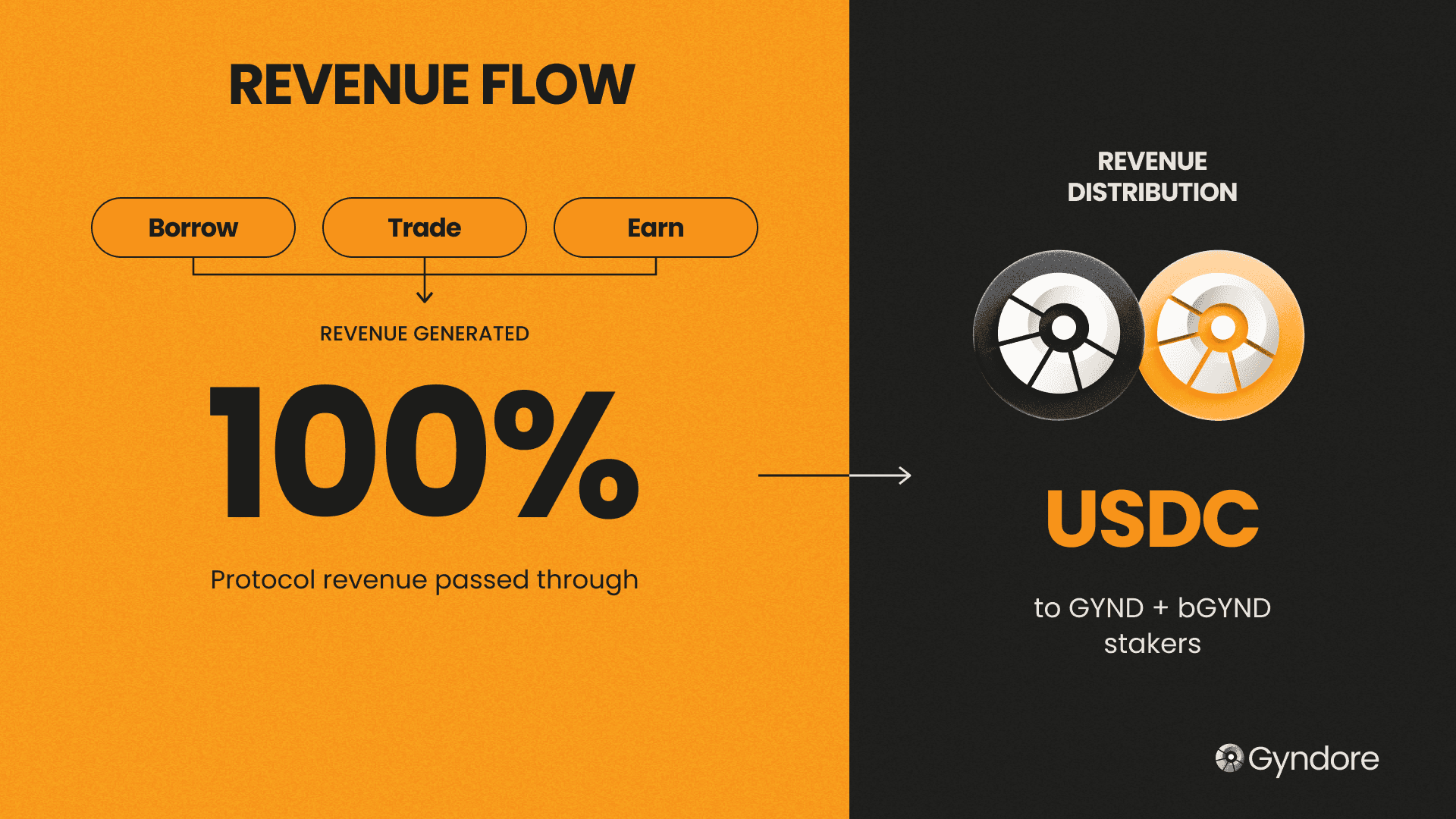
Trading fees to stakers
The DEX charges a fee on every swap, and the rate varies by pool pair. The liquidity providers whose capital filled the trade keep 80% of it, and the protocol takes a fixed one-fifth, 20%, keeping none of it: 100% is swapped to USDC and passed through to the GYND and bGYND staking pool, where it becomes claimable revenue for stakers.
Rewards accrue every block, and a staker holding GYND or bGYND can claim their slice of the accumulated USDC at any time, in proportion to their stake, with 1 bGYND counting as 1 GYND. This is what makes GYND a fee token in the literal sense: every dollar the DEX earns for the protocol is paid straight into the staking pool, so holding and staking GYND is a direct claim on what the platform earns from trading.
How DropWave related
DropWave was a separate participation campaign, not a source of protocol revenue. Chips awarded GynPoints and a leaderboard place; GynPoints were not a fixed amount of GYND or bGYND. Community rewards are distributed as bGYND from the bonding contract rather than from swap fees, primarily to reward liquidity providers: token distribution, not revenue. Staked, each bGYND has the same 1:1 weight as GYND in the pool. Unbonding pays 70% of GYND's market value in USDC, burns the submitted bGYND, and claims GYND 1:1 after a 24-hour cooldown. New requests require GYND to trade above $0.10. Captured USDC funds protocol-owned liquidity and GYND buybacks. Bonded Model has the full mechanics.
No hidden levers
Because both core protocols are immutable, there are no discretionary fee changes, no emergency toggles, and no admin who can redirect revenue. Staker revenue share is part of that fixed design from launch. What you read here is what the contracts do, forever.